

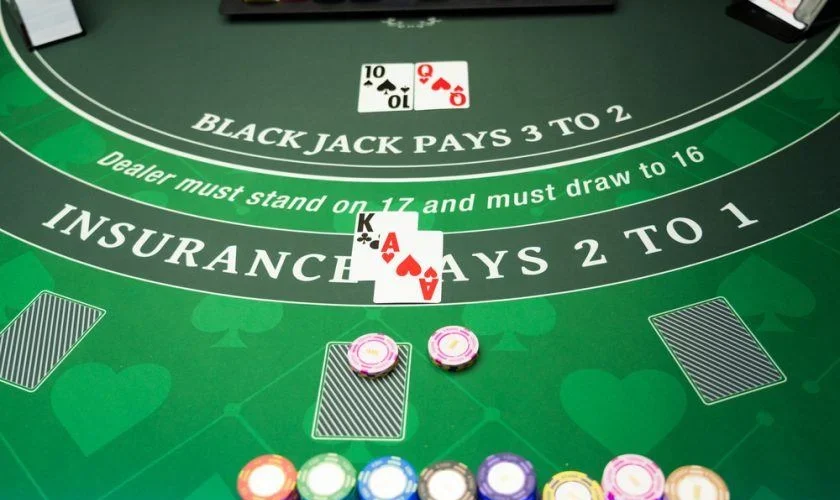
Walk up to any bustling blackjack pit in Las Vegas or Atlantic City, and you can usually identify the novice players within two rounds. They lean forward intently, nervously count the pips on their cards, consult their friends on whether sixteen is “too risky,” and breathe an audible sigh of relief whenever their total lands on eighteen or nineteen.
A few spots down, an experienced player operates with an entirely different rhythm. Their gestures are calm and decisive, their bets adjust with quiet purpose, and they seem almost unbothered when dealt an uncomfortable hand.
Blackjack carries a unique reputation as a casino table game where player agency actually matters. Yet the divide between someone casually passing time and someone who treats the felt with strategic respect is vast. The distinction rarely comes down to secret card tricks or superhuman memorization. Instead, it stems from how players frame the objective, process mathematical realities, and manage their emotions when variance swings against them.
Redefining the Objective: Beating the Dealer, Not Chasing Twenty-One
The most pervasive misconception among recreational players is that the goal of blackjack is to get as close to twenty-one as possible. Beginners treat the game like a race toward a target score, continually pulling cards in an effort to construct an impressive hand.
Seasoned players understand that the target score is secondary. The true objective is singular: beat the dealer’s final hand or let the dealer bust.
Because dealers are bound by rigid house rules—they must hit until reaching at least seventeen, without the liberty to exercise personal judgment—the table dynamic is inherently asymmetric. An experienced player treats a hand of twelve or thirteen not as a broken combination, but as a finished holding if the dealer is currently sitting on an exposed five or six. While an amateur sees an ugly twelve and worries about having too few points, a veteran recognizes that the dealer has an elevated probability of exceeding twenty-one. Standing on twelve feels counterintuitive to someone chasing twenty-one, but it is standard procedure for anyone tracking conditional outcomes.
Looking Across the Felt: The Primacy of the Upcard
Beginner decision-making is largely self-centered. A novice evaluates their own two cards in a vacuum, deciding whether to hit or stand based entirely on personal comfort levels. If they hold sixteen, they dread busting and frequently freeze, regardless of what the dealer shows.
Experienced players invert this focus. Before glancing at their own cards, their eyes go directly to the dealer’s visible upcard. In modern blackjack strategy, your cards only gain meaning in relation to that single exposed value.
A hand of sixteen against a dealer’s seven, eight, or nine is mathematically unfavorable, but hitting remains the mathematically superior play because the dealer is heavily favored to finish with a seventeen or higher. Standing guarantees a loss far more often than hitting does, even though taking a hit frequently busts the player. Veterans accept that some decisions are not about engineering a win; they are about loss minimization. Playing the percentages means choosing the least harmful option over a long horizon, a nuance that novices often resist because busting feels worse emotionally than quietly losing to a dealer’s eighteen.
Calculated Aggression: Doubling Down and Splitting Pairs
Recreational players often treat doubling down and splitting pairs with extreme hesitation. Handing the dealer another stack of chips feels like unnecessary exposure, especially if the initial cards look mediocre. Beginners frequently double only on obvious hands like an eleven, and they often split only high pairs like tens or face cards.
Experienced players approach these opportunities from the opposite direction. They recognize that basic flat-betting against the house edge is a slow drain, and that the moments of true player advantage come precisely from aggressive doubling and splitting.
For instance, veteran players routinely double down on soft totals—hands containing an Ace counted as eleven, such as an Ace-three or Ace-six—when the dealer exposes a weak upcard like a four, five, or six. Beginners often view soft totals as fragile, but experienced players see them as a free offensive swing where they cannot immediately bust on one additional card while the dealer is in trouble.
Crucially, experienced players maintain strict discipline with pair splitting:
-
They never split tens, knowing that a pat twenty is already one of the strongest defensive positions at the table.
-
They always split Aces and eights, treating two single Aces as separate offensive opportunities and breaking up a sixteen (two eights) to escape the worst starting total in the game.
-
They never split fives, choosing instead to double down on a starting ten against weak dealer cards.
The Mirage of Insurance and Side Bets
Casinos love proposition wagers and decorative side bets because they inject high house margins into otherwise low-edge games. When a dealer reveals an Ace, beginners frequently bite on the offer for insurance, especially if the player is holding a natural blackjack and the dealer offers “even money.”
To an inexperienced player, taking even money feels like guaranteed safety—a quick, painless way to lock in a profit without risking a push.
To an experienced player, standard insurance is considered a sucker bet. Mathematically, insurance is simply a secondary side wager that the dealer’s facedown card has a value of ten. In a standard multi-deck shoe, the odds against that hole card being a ten do not justify the two-to-one payout. Taking even money reduces the long-term payout of hitting a natural blackjack from the standard rate down to a flat one-to-one return. Unless an advantage player is actively counting cards and knows the shoe is rich in tens, insurance is bypassed without a second thought.
The same discipline applies to table side bets like three-card combinations or pair jackpots. While novices view these as exciting micro-lotteries that add flavor to the hand, veterans know these wagers carry house edges that often exceed ten percent, eroding any strategic edge built on the primary layout.
Scrutinizing Table Rules Before Sitting Down
A novice walks into a casino and sits at whatever empty stool has an agreeable minimum bet. An experienced player scans the felt like an inspector checking building codes.
Not all blackjack games are created equal. Minor rule variations dramatically alter the mathematical landscape:
-
The 6:5 Payout Trap: Traditional blackjack pays 3:2 on a natural, meaning a ten-dollar bet yields fifteen dollars. In recent years, casinos have widely introduced tables paying 6:5, yielding only twelve dollars for the same result. This single change balloons the baseline house advantage dramatically. Experienced players simply refuse to sit at a 6:5 table.
-
Dealer Action on Soft Seventeen: A table where the dealer stands on all seventeens is significantly more player-friendly than one where the dealer hits soft seventeen (an Ace and a six).
-
Surrender Options: Late surrender allows players to forfeit half their bet on terrible starting positions against strong dealer upcards. While beginners rarely use it because giving up feels like defeat, veterans use surrender systematically to preserve bankroll equity.
Emotional Discipline and the Myth of Table Karma
Perhaps the starkest divergence between beginners and seasoned players is psychological. Beginners routinely get frustrated by other players’ decisions. If someone sitting at third base—the seat immediately to the dealer’s right—hits a twelve against a six, busts, and draws a ten that would have busted the dealer, novices erupt. They blame their table mates for “ruining the shoe” or “taking the dealer’s bust card.”
Experienced players realize that table position and the erratic decisions of other players have zero mathematical bearing on their own long-term odds. The next card out of the shoe is completely unknown; an irregular hit by a novice is just as likely to save the table on the following hand as it is to hurt it.
Beyond etiquette myths, experienced players detach their emotions from short-term variance. They calculate their bankroll in betting units rather than rent money, expect long losing streaks as an inevitable feature of probability, and stick rigidly to optimal strategy rather than chasing losses with erratic wagers.
Where beginners see a game of instincts, hunches, and good luck charms, experienced players see an ongoing exercise in risk mitigation and statistical execution. The cards will fall where they may, but the decisions at the felt remain under complete control.